

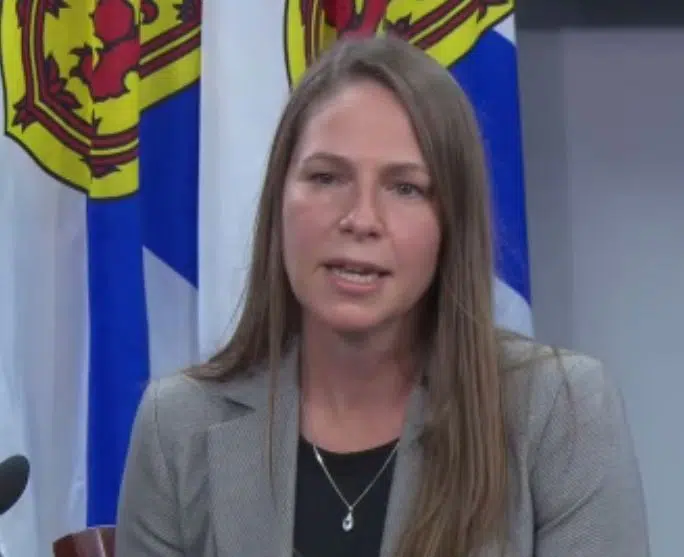
Becky Druhan, Nova Scotia's former minister of justice, is pictured in this undated file photo. (Acadia Broadcasting)
Former Nova Scotia justice minister Becky Druhan is calling on the province to reconsider its approach to illegal cannabis, arguing that stronger enforcement alone will not address the underlying problems in the current system.
Earlier this Month, Premier Tim Houston and Justice Minister Scott Armstrong announced the province wanted to crack down on illegal cannabis storefronts.
Since making that announcement, they have faced backlash from indigenous groups, including the Sipekne’katik, who banned the Premier and Justice Minister from their lands.
In a letter to Houston and Armstrong, Druhan says Nova Scotia has one of the most restrictive cannabis frameworks in the country. With the Nova Scotia Liquor Corporation acting as the primary authorized seller and no meaningful pathways for private or community-based retailers, she argues the system limits access, particularly in rural areas, and pushes consumers toward unregulated dispensaries.
Druhan says while public safety concerns tied to illegal cannabis are valid, the province’s recent enforcement directive does not meaningfully change how laws are already being applied. She points to the RCMP’s response that officers are already enforcing existing legislation, as well as opposition from the Assembly of Nova Scotia Mi’kmaw Chiefs, which has criticized the directive as unilateral and lacking respectful engagement.
Taken together, Druhan says those responses highlight the need for a solutions-based approach focused on regulation rather than escalating enforcement.
In her letter, Druhan outlines what she describes as a more modern and balanced model, pointing to other provinces that have combined licensing systems, training requirements, product standards, inspections, and public education.
She argues those approaches have expanded legal access and reduced illegal activity without compromising health or safety.
Druhan says a similar approach in Nova Scotia could create clear licensing options for small, private, and community-based operators, expand legal access in rural communities, and improve collaboration with Mi’kmaw communities. She also says better public education could help consumers understand the difference between legal and illegal retail, while allowing enforcement efforts to focus on genuine risks such as organized crime.
She emphasizes that reform does not mean abandoning enforcement, but rather using it strategically alongside regulatory changes that allow people to operate legally and responsibly.
Although she is no longer a member of cabinet, Druhan says she remains willing to contribute her experience to help the province develop a forward-looking cannabis policy that improves safety, supports local economic participation, and builds trust with communities across Nova Scotia.